Public Asset Cache
p2pstream can cache public proxy-forward responses on the proxy server for static assets.
What It Is
Cache rules are global traffic policy rules evaluated after WAF, rate limits, traffic shaping, and route/target selection. Cache hits still pass through those earlier policy layers before p2pstream serves the cached object.
The cache is designed for public static assets such as CSS, JavaScript, images, SVGs, and fonts. It is not a session or API response cache.
When It Matters
Use cache rules when public frontend assets are repeatedly fetched through p2pstream and the upstream can safely share those assets between visitors.
Runtime Behavior
Authorization requests are never cached
Any request that includes an Authorization header always bypasses the cache, regardless of cache rule configuration. If you are caching API responses, ensure they do not require this header.
Requests are never cached when they include:
Authorization,- a request body,
Range,- WebSocket or other upgrade headers,
- methods other than
GETorHEAD.
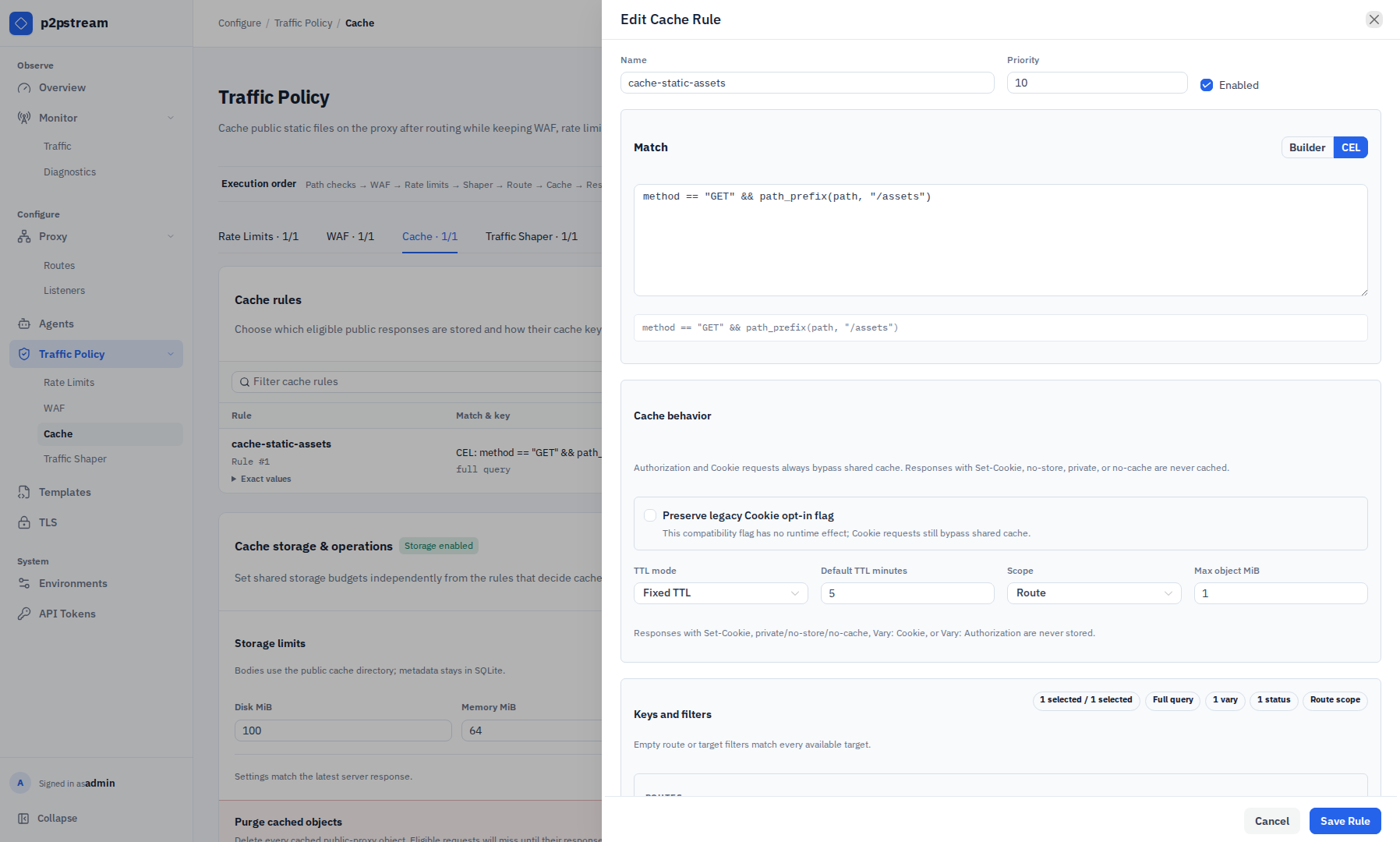
Requests with Cookie always bypass shared cache. The legacy allow_cookie_requests field may still appear in older configuration, but it is preserved only for compatibility and has no runtime effect.
Responses are never cached when they include Set-Cookie, Cache-Control: no-store, private, or no-cache, Vary: *, Vary: Cookie, Vary: Authorization, a disallowed status code, or a body larger than the rule maximum object size.
The default configured Vary header is Accept-Encoding. Fixed TTL uses the rule TTL, default 3600000 ms. Origin TTL respects s-maxage, max-age, and Expires, falling back to the rule TTL when the origin has no usable TTL.
Cached bodies are stored under PUBLIC_CACHE_DIR when set, otherwise ${CONFIG_DIR}/cache/public. Metadata is stored in SQLite.
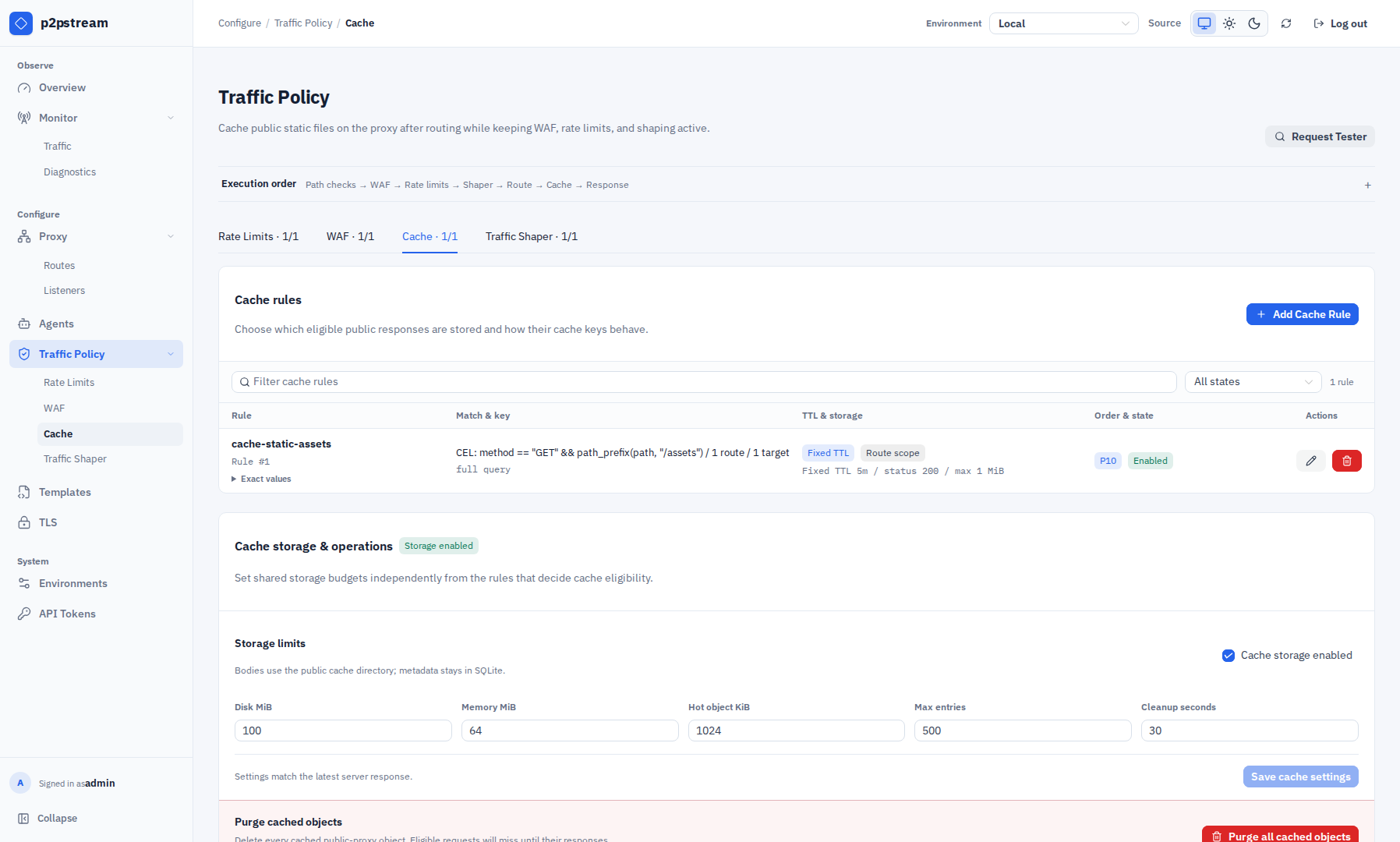
Manage both parts under Traffic Policy → Cache. The filterable rules table determines eligibility and cache keys. The separate Cache storage & operations section controls shared storage budgets and cleanup, and contains the destructive purge action. Unsaved storage changes are kept distinct from the last server response so operators can review them before saving.
Common Mistakes
- Enabling cookie-tolerant caching on dynamic pages instead of precise asset paths like
/_nuxt/. - Expecting
Authorizationrequests to use the cache. - Trying to cache static targets or redirect routes.
- Treating
Vary: Accept-Encodingas a problem; it is the normal compressed-asset variant key.